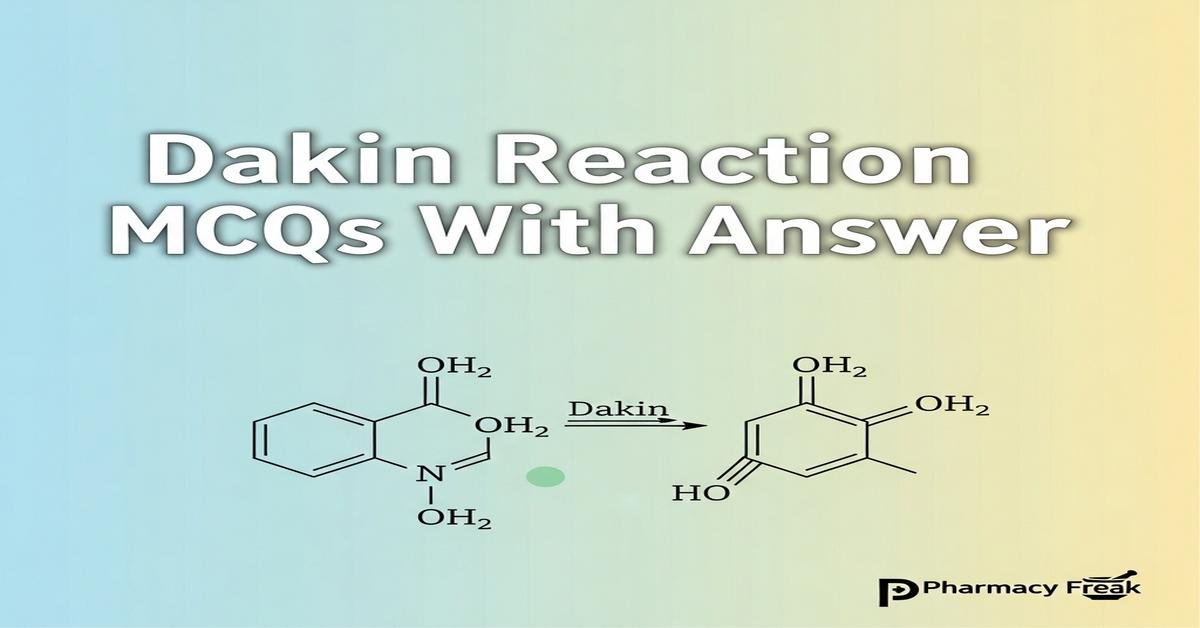
Introduction: The Dakin reaction MCQs With Answer is a focused study resource for B.Pharm students preparing for medicinal chemistry and pharmaceutical organic chemistry exams. This Student-friendly guide covers the Dakin reaction mechanism, reagents (hydrogen peroxide, alkaline medium), substrate scope (ortho‑ and para‑hydroxyaryl aldehydes/ketones), common products (catechols, hydroquinones), key intermediates, and practical applications in drug synthesis. Clear explanations and targeted multiple-choice questions reinforce concepts such as aryl migration, peroxyhemiacetal formation, and factors affecting yield. Ideal for revision, practice tests, and classroom preparation. Now let’s test your knowledge with 50 MCQs on this topic.
Q1. Which substrates undergo the Dakin reaction most readily?
- Ortho‑ and para‑hydroxyaryl aldehydes and ketones
- Meta‑hydroxyaryl aldehydes and ketones
- Unsubstituted benzaldehyde only
- Aliphatic aldehydes with no aromatic ring
Correct Answer: Ortho‑ and para‑hydroxyaryl aldehydes and ketones
Q2. What is the primary oxidant used in the classical Dakin reaction?
- Hydrogen peroxide (H2O2)
- Chromium trioxide (CrO3)
- Pyridinium chlorochromate (PCC)
- Manganese dioxide (MnO2)
Correct Answer: Hydrogen peroxide (H2O2)
Q3. Which condition is essential for the Dakin reaction to proceed?
- Basic (alkaline) medium
- Strongly acidic medium
- Anhydrous, neutral conditions
- High pressure hydrogen atmosphere
Correct Answer: Basic (alkaline) medium
Q4. The first mechanistic step of the Dakin reaction involves:
- Nucleophilic attack of hydroperoxide anion on the carbonyl
- Electrophilic aromatic substitution on the ring
- Radical hydrogen abstraction by peroxide
- Metal-catalyzed oxidative insertion
Correct Answer: Nucleophilic attack of hydroperoxide anion on the carbonyl
Q5. Which intermediate is formed after hydroperoxide attacks the carbonyl in the Dakin mechanism?
- Peroxyhemiacetal (peroxyhydrate) intermediate
- Acyl radical intermediate
- Carbocation stabilized by ring
- Benzyl alkoxide intermediate
Correct Answer: Peroxyhemiacetal (peroxyhydrate) intermediate
Q6. During the Dakin reaction, which group migrates in the rearrangement step?
- Aryl group migrates to oxygen (aryl migration)
- Hydride migrates to peroxide oxygen
- Alkyl group migrates to carbonyl carbon
- No migration; direct elimination occurs
Correct Answer: Aryl group migrates to oxygen (aryl migration)
Q7. What major type of product is obtained from a para‑hydroxybenzaldehyde via Dakin reaction?
- Hydroquinone (para‑dihydroxybenzene)
- p‑Nitrophenol
- Benzyl alcohol
- Benzoic acid
Correct Answer: Hydroquinone (para‑dihydroxybenzene)
Q8. What by‑product is typically generated from the carbonyl fragment in a Dakin oxidation of an aldehyde?
- Formate ion (HCOO–)
- Carbon dioxide gas
- Methanol
- Acetone
Correct Answer: Formate ion (HCOO–)
Q9. Who is the Dakin reaction named after?
- Henry Drysdale Dakin
- August Kekulé
- Robert B. Woodward
- Adolf von Baeyer
Correct Answer: Henry Drysdale Dakin
Q10. Which of the following best describes the role of base in the Dakin reaction?
- Generates the hydroperoxide anion that attacks the carbonyl
- Protonates the carbonyl to increase electrophilicity
- Complexes with substrate to form a stable salt
- Reduces peroxide to water
Correct Answer: Generates the hydroperoxide anion that attacks the carbonyl
Q11. The Dakin reaction is mechanistically most similar to which reaction?
- Baeyer–Villiger oxidation (both involve nucleophilic peroxide addition and migration)
- Friedel–Crafts acylation
- Wittig reaction
- Nitro reduction
Correct Answer: Baeyer–Villiger oxidation (both involve nucleophilic peroxide addition and migration)
Q12. Meta‑hydroxyaryl substrates are generally:
- Poor substrates for the Dakin reaction
- Excellent substrates giving high yields
- Converted into nitro derivatives
- Transformed into ketones preferentially
Correct Answer: Poor substrates for the Dakin reaction
Q13. How does an electron‑donating substituent on the aromatic ring affect the Dakin reaction rate?
- Generally increases the reaction rate by stabilizing the migration transition state
- Always stops the reaction completely
- Has no effect on the reaction rate
- Converts the mechanism to radical pathway
Correct Answer: Generally increases the reaction rate by stabilizing the migration transition state
Q14. Which solvent system is commonly used in laboratory Dakin reactions?
- Aqueous alkaline medium (water/NaOH) often with H2O2
- Anhydrous ether without water
- Conc. sulfuric acid as solvent
- Liquid ammonia
Correct Answer: Aqueous alkaline medium (water/NaOH) often with H2O2
Q15. In pharmaceutical synthesis, Dakin reaction is mainly used to prepare which class of compounds?
- Catechols and hydroquinones used as intermediates
- Aliphatic alcohols for formulation
- Peptide linkers for proteins
- Primary amines for APIs
Correct Answer: Catechols and hydroquinones used as intermediates
Q16. What is the effect of a strong electron‑withdrawing group at the para position on Dakin reactivity?
- Decreases reactivity by destabilizing the migration step
- Greatly accelerates the reaction in all cases
- Leads to formation of azo compounds
- Causes immediate polymerization
Correct Answer: Decreases reactivity by destabilizing the migration step
Q17. Which species performs the nucleophilic attack on the carbonyl carbon?
- Hydroperoxide anion (HOO–)
- Hydroxide anion only (OH–)
- Bromide ion (Br–)
- Alkoxide generated from solvent
Correct Answer: Hydroperoxide anion (HOO–)
Q18. The Dakin reaction generally requires which temperature condition for practical lab runs?
- Mild temperatures (0–40 °C) are commonly used
- Extremely high temperatures (>200 °C)
- Cryogenic temperatures (<–78 °C)
- Supercritical CO2 conditions
Correct Answer: Mild temperatures (0–40 °C) are commonly used
Q19. Which of these is a potential side reaction in Dakin oxidations?
- Overoxidation or ring‑cleavage leading to complex mixtures
- Formation of Grignard reagents
- Hydrogenation of the aromatic ring
- Direct chlorination of ring
Correct Answer: Overoxidation or ring‑cleavage leading to complex mixtures
Q20. If a para‑hydroxyacetophenone is subjected to Dakin reaction, the expected major product is:
- p‑Hydroxyphenol (hydroquinone derivative depending on substitution)
- p‑Nitrophenol
- Acetone and phenol
- Benzaldehyde
Correct Answer: p‑Hydroxyphenol (hydroquinone derivative depending on substitution)
Q21. Which analytical technique is most useful to confirm formation of dihydroxybenzene products?
- High‑performance liquid chromatography (HPLC) and NMR
- Flame photometry only
- Polarimetry exclusively
- Simple litmus test
Correct Answer: High‑performance liquid chromatography (HPLC) and NMR
Q22. In the Dakin mechanism, collapse of the peroxy intermediate yields what immediate bond formation?
- New C–O (aryl‑oxygen) bond after aryl migration
- New C–C bond between two rings
- S–O bond formation from thiol impurities
- New N–O bond forming nitroso compounds
Correct Answer: New C–O (aryl‑oxygen) bond after aryl migration
Q23. Which reagent variation can be used as an alternative oxidant in modified Dakin procedures?
- Urea‑hydrogen peroxide (UHP) or peracids in some adaptations
- Lithium aluminum hydride (LAH)
- Sodium borohydride (NaBH4)
- Sodium cyanoborohydride
Correct Answer: Urea‑hydrogen peroxide (UHP) or peracids in some adaptations
Q24. What is a common workup step after finishing a Dakin reaction?
- Acidification and extraction to isolate phenolic products
- Distillation under reduced pressure to remove H2 gas
- Quenching with organolithium reagent
- Chromatography under strongly acidic conditions only
Correct Answer: Acidification and extraction to isolate phenolic products
Q25. Which structural requirement prevents simple benzaldehyde from undergoing Dakin oxidation?
- Absence of an ortho‑ or para‑hydroxyl group on the ring
- Presence of a nitro group at any position
- Benzaldehyde is too reactive and polymerizes
- Benzaldehyde has no carbonyl group
Correct Answer: Absence of an ortho‑ or para‑hydroxyl group on the ring
Q26. The Dakin reaction converts a carbonyl substituent into which functional group on the ring?
- Hydroxyl group (phenolic OH at that ring position)
- Carboxyl group directly attached to ring
- Amine group
- Alkyl chain extension
Correct Answer: Hydroxyl group (phenolic OH at that ring position)
Q27. Which statement about the rate‑determining step is most consistent with mechanistic studies?
- Aryl migration is often the rate‑determining step
- Product isolation is the rate‑determining step
- Initial H2O2 generation is rate limiting when supplied externally
- Simple proton transfer steps are universally rate determining
Correct Answer: Aryl migration is often the rate‑determining step
Q28. How does steric hindrance adjacent to the hydroxyl group affect the Dakin reaction?
- Can slow the reaction by hindering transition‑state geometry
- Always increases the yield by directing migration
- Has no effect since only electronics matter
- Makes the peroxide incapable of decomposing
Correct Answer: Can slow the reaction by hindering transition‑state geometry
Q29. In terms of green chemistry, why is the Dakin reaction attractive?
- Uses hydrogen peroxide, which produces water as a benign by‑product
- Requires heavy metal catalysts in large amounts
- Generates toxic organometallic wastes
- Operates only at extremely high energy costs
Correct Answer: Uses hydrogen peroxide, which produces water as a benign by‑product
Q30. Which pharmaceutical intermediate could be prepared via a Dakin transformation?
- Catechol intermediates for cardiovascular or antiseptic agents
- Large peptide APIs directly
- Metal complexes for contrast agents
- Alkyl halides for solvent production
Correct Answer: Catechol intermediates for cardiovascular or antiseptic agents
Q31. What happens to ketone substrates in the Dakin reaction compared to aldehydes?
- They can undergo similar oxidation if ortho/para‑OH is present, giving phenolic products
- They are completely inert under all conditions
- They always form esters instead of phenols
- They explode in presence of peroxide
Correct Answer: They can undergo similar oxidation if ortho/para‑OH is present, giving phenolic products
Q32. Why is controlling peroxide concentration important in Dakin reactions?
- Excess peroxide can cause overoxidation and decomposition
- Peroxide concentration has no impact on selectivity
- Low peroxide always yields explosive mixtures
- Peroxide neutralizes the base if concentrated
Correct Answer: Excess peroxide can cause overoxidation and decomposition
Q33. Which safety precaution is most relevant when performing a Dakin reaction?
- Careful control of peroxide handling due to oxidizing hazards
- Use of pressurized hydrogen gas cylinders
- Working in a closed autoclave at high pressure as standard
- Avoiding gloves because peroxide is harmless
Correct Answer: Careful control of peroxide handling due to oxidizing hazards
Q34. What is the fate of the original carbonyl carbon in the Dakin oxidation of an aldehyde?
- Converted to a small carboxylate by‑product (formate) and removed
- Remains unchanged in the final product
- Is converted into nitrogen gas
- Is incorporated into polymeric residue only
Correct Answer: Converted to a small carboxylate by‑product (formate) and removed
Q35. Which reagent combination would you choose to perform a classical Dakin oxidation?
- H2O2 and NaOH in aqueous solution
- LiAlH4 in ether
- SOCl2 in dichloromethane
- Hydrazine hydrate under acidic conditions
Correct Answer: H2O2 and NaOH in aqueous solution
Q36. A substrate with both ortho‑ and para‑hydroxyl groups may yield:
- Mixtures of dihydroxybenzene isomers or polyhydroxylated products depending on conditions
- Only mono‑hydroxylated benzene compounds
- Exclusive formation of azo compounds
- Only unchanged starting material
Correct Answer: Mixtures of dihydroxybenzene isomers or polyhydroxylated products depending on conditions
Q37. How does pH influence selectivity in the Dakin reaction?
- Alkaline pH is necessary for formation of hydroperoxide anion and selectivity
- Strongly acidic pH gives the best yields of phenols
- Neutral pH always maximizes reaction rate
- pH has no effect and is irrelevant
Correct Answer: Alkaline pH is necessary for formation of hydroperoxide anion and selectivity
Q38. Which analytical observation indicates successful conversion to hydroquinone from p‑hydroxybenzaldehyde?
- Appearance of signals for two equivalent aromatic hydroxyls in NMR and appropriate mass change
- Loss of aromatic signals entirely in NMR
- Observation of strong aliphatic peaks only
- Formation of a gaseous product visible in NMR tube
Correct Answer: Appearance of signals for two equivalent aromatic hydroxyls in NMR and appropriate mass change
Q39. Which functional group on the ring discourages Dakin transformation?
- Strong electron‑withdrawing groups like nitro (–NO2)
- Electron‑donating methoxy groups
- Hydroxyl groups at ortho/para
- Alkyl substituents
Correct Answer: Strong electron‑withdrawing groups like nitro (–NO2)
Q40. Modified Dakin reactions can be used to achieve selective oxidation when:
- Peroxide source and base strength are carefully tuned
- No control of reagent stoichiometry is used
- Reaction is run at uncontrolled high temperature only
- Substrate is used in huge excess without base
Correct Answer: Peroxide source and base strength are carefully tuned
Q41. Which statement best distinguishes Dakin from Reimer–Tiemann reactions?
- Dakin is oxidative cleavage of carbonyls to phenols; Reimer–Tiemann forms ortho‑formylation of phenols
- They are identical reactions with different names
- Reimer–Tiemann uses H2O2 as the main reagent like Dakin
- Dakin performs amination of aromatic rings
Correct Answer: Dakin is oxidative cleavage of carbonyls to phenols; Reimer–Tiemann forms ortho‑formylation of phenols
Q42. Which experimental parameter often improves yields in problematic Dakin reactions?
- Using phase‑transfer catalysts or co‑solvents to enhance solubility
- Increasing metallic contaminants deliberately
- Removing all water to make the mixture anhydrous
- Adding excess strong acids
Correct Answer: Using phase‑transfer catalysts or co‑solvents to enhance solubility
Q43. If an ortho‑hydroxyaryl ketone undergoes Dakin oxidation, which product class is expected?
- Ortho‑dihydroxybenzene (catechol) derivatives
- Aliphatic diols exclusively
- Only nitriles
- Polyethers
Correct Answer: Ortho‑dihydroxybenzene (catechol) derivatives
Q44. In mechanistic discussions, which bond-breaking event completes the Dakin rearrangement?
- Cleavage of the C–C bond between the migrating aryl carbon and the original carbonyl carbon to release a carboxylate
- Cleavage of aromatic C–H bonds exclusively
- Cleavage of C–N bonds to give amines
- Breaking of S–S bonds
Correct Answer: Cleavage of the C–C bond between the migrating aryl carbon and the original carbonyl carbon to release a carboxylate
Q45. What type of electron movement characterizes the aryl migration step?
- Concerted or pseudoconcerted migration to oxygen with bond reorganization
- Simple free radical chain propagation only
- SN1 carbocation formation exclusively
- Pericyclic sigmatropic shift without oxygen involvement
Correct Answer: Concerted or pseudoconcerted migration to oxygen with bond reorganization
Q46. Which reagent would most likely quench residual peroxide after a Dakin workup?
- Sodium sulfite (Na2SO3) or sodium thiosulfate (Na2S2O3)
- Stronger oxidants like KMnO4
- Organometallic reagents like n‑BuLi
- Conc. nitric acid
Correct Answer: Sodium sulfite (Na2SO3) or sodium thiosulfate (Na2S2O3)
Q47. For scale‑up in industry, what is a major consideration for Dakin reactions?
- Safe handling and dosing of peroxide to avoid runaway oxidation
- Using open flames to speed reactions
- Eliminating all solvent instantly
- Storing large volumes of concentrated acid on site
Correct Answer: Safe handling and dosing of peroxide to avoid runaway oxidation
Q48. The Dakin reaction is especially useful for converting which agrochemical or drug intermediate motif?
- Hydroxybenzaldehyde motifs to dihydroxybenzenes used as APIs intermediates
- Long‑chain alkanes to polymers
- Sugars into amino acids directly
- Metal salts into organometallic drugs
Correct Answer: Hydroxybenzaldehyde motifs to dihydroxybenzenes used as APIs intermediates
Q49. Which reagent condition would most likely suppress undesired overoxidation?
- Controlled, slight excess of H2O2 with temperature regulation
- Massive excess of peroxide at high temperature
- No base present during reaction
- Adding metallic iron powder to catalyze radical pathways
Correct Answer: Controlled, slight excess of H2O2 with temperature regulation
Q50. When designing MCQ practice for B.Pharm students on the Dakin reaction, which focus is most pedagogically valuable?
- Understanding mechanism, reagents, substrate scope and pharmaceutical applications
- Memorizing random unrelated reagent names
- Focusing exclusively on inorganic salt solubility
- Ignoring safety and scalability considerations
Correct Answer: Understanding mechanism, reagents, substrate scope and pharmaceutical applications


I am a Registered Pharmacist under the Pharmacy Act, 1948, and the founder of PharmacyFreak.com. I hold a Bachelor of Pharmacy degree from Rungta College of Pharmaceutical Science and Research. With a strong academic foundation and practical knowledge, I am committed to providing accurate, easy-to-understand content to support pharmacy students and professionals. My aim is to make complex pharmaceutical concepts accessible and useful for real-world application.
Mail- Sachin@pharmacyfreak.com